


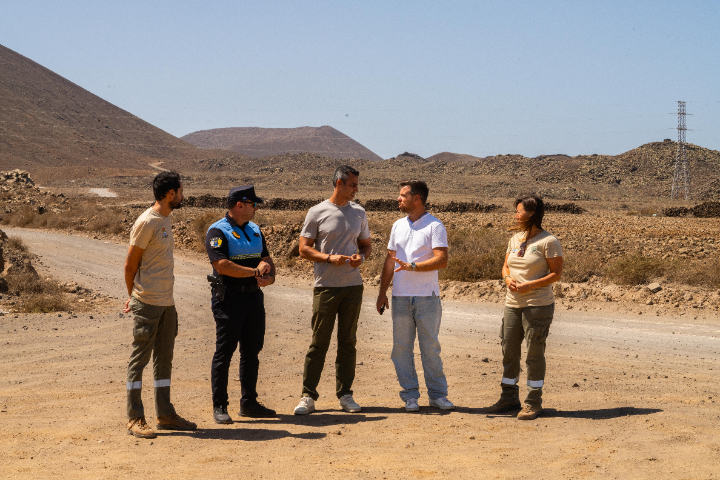
La Oliva Town Council, through its Department of the Environment, headed by David Fajardo, together with the Local Police, has banned quad, buggy and similar recreational vehicle businesses from operating on eight municipally owned rural tracks that are particularly sensitive due to their environmental value. The aim is not only to protect the municipality’s sensitive natural environment, but also to safeguard the road safety of hikers and cyclists, responding to a demand from local residents themselves.
In recent months, residents have raised concerns with the Town Council, through written complaints and petitions, about the problems they face as a result of this type of vehicle travelling through the area.
Joint work between the Local Police headquarters and the Department of the Environment concluded that the ban is legally viable and that the Town Council has both the municipal authority and express backing in its Municipal Traffic Ordinance to restrict these vehicles on specific tracks. The commercial activity is therefore not being banned outright, but reorganised in line with the island-wide ordinance, meaning businesses will continue to operate this activity on the designated stretches.
The report also recommends that the measure be implemented through the appropriate municipal instrument, backed by technical studies justifying the choice of tracks and accompanied by specific signage at all access points.
The mayor of La Oliva, Isaí Blanco, said: “We are responding to a demand that exists in various parts of the municipality, and we are doing so rigorously, with technical reports and full legal safeguards. Tourism activity has to be compatible with the conservation of our territory, the peace and quiet of our residents, and the traditional use of our tracks.”
Blanco also stressed that “La Oliva has an extraordinary natural heritage that we must protect. This is not about acting against any economic activity, but about regulating certain uses where they are causing problems and where the technical reports themselves tell us that intervention is necessary.”
Eight tracks included in the proposal
The report drawn up by the team of Environmental Guides identifies eight routes to be excluded from quad, buggy and similar recreational vehicle traffic:
1. Corralejo–El Cotillo, via Majanicho.
2. Corralejo–Lajares, via Las Calderas.
3. Lajares–El Cotillo, via Cañada Melián.
4. El Cotillo–Montaña de Tindaya, via Esquinzo.
5. Tindaya–La Oliva, via Montaña La Oliva.
6. Valle de Fenimoy.
7. Valle de Fimapaire.
8. Montaña Negra–Cien Hombres.
The reasons behind the measure include the protection of biodiversity and environmentally sensitive areas, proximity to SPA and SAC zones, impacts on homes and livestock farms, safety on tracks shared with pedestrians and cyclists, and soil degradation, erosion and dust generation.
Particularly significant is the case of the track between Corralejo, Majanicho and El Cotillo, which runs entirely through the Costa Norte de Fuerteventura Special Protection Area for Birds and largely overlaps with the Huella de Leyenda HL3 trail. Also included are tracks near Tindaya, Esquinzo, Fenimoy, Fimapaire and Cien Hombres, where factors relating to protected areas, homes, livestock farms, footpaths and land degradation come together.
The councillor for the Environment, David Fajardo, said: “This is an action that we consider necessary and that responds to a real demand from the municipality. We have received letters, petitions and numerous requests from our residents to take action over a situation that has long been causing concern among residents and users of our tracks.”
“From the Department of the Environment, we commissioned a specific report from the Environmental Guides to technically determine which tracks need special protection, and we have worked together with the Local Police to find a legally viable solution,” Fajardo explained.
The councillor insisted that “La Oliva cannot allow certain recreational uses to end up damaging tracks, affecting protected areas or interfering with the road safety of residents, livestock farmers, hikers and cyclists. We need to strike a balance between tourism activity and conservation, but in the most sensitive locations, protecting the land must take priority.”
Next steps
Following this first step, the Council will also install the relevant signage at the access points to the affected tracks.
This action reflects the local government’s commitment to protecting La Oliva’s sensitive natural environment and ensuring the public and road safety of residents.