


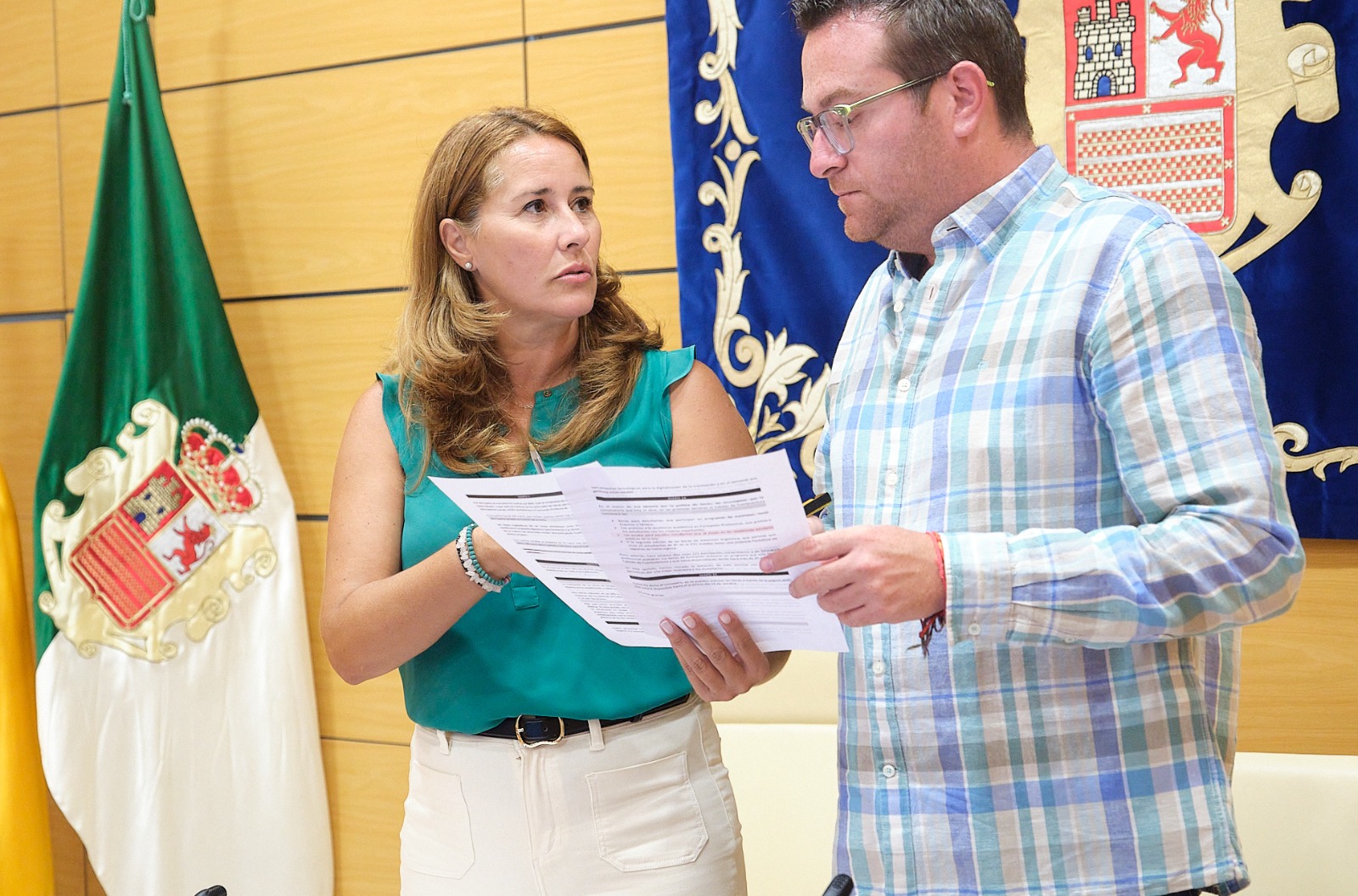
Lola García: “We cannot take part in an institutional photo opportunity when we have spent the whole term requesting meetings, raising demands and waiting for commitments to be fulfilled, without receiving any response”
The Cabildo de Fuerteventura did not take part in the event held on Wednesday to mark the visit of the Canary Islands Government’s Education Minister, Poli Suárez, for the official opening of the school year, in protest at the repeated lack of response to the Island’s educational needs and to the numerous requests for meetings made by the island institution throughout this term.
The president of the Cabildo, Lola García, stated that the decision “is not about one isolated issue, but about three years of a lack of dialogue, unanswered demands and commitments that have still not materialised”.
At the start of the term, the Canary Islands Government’s Education Department, the Cabildo and the six ayuntamientos agreed to draw up a roadmap to advance the Island’s educational infrastructure. At that meeting, needs relating to school buildings, staffing, school transport, special education and infrastructure were already raised. Since then, the Cabildo has repeatedly requested a further meeting to review that planning, update priorities and move forward with implementation, without receiving any response.
The situation is particularly worrying given the pressure the majorero education system is under. Figures from the Consejo Escolar de Canarias (Canary Islands School Council) show that Fuerteventura, along with Lanzarote, is among the islands with the largest class sizes, in both state and semi-private schools.
For the Cabildo, this shows that pupil numbers have grown beyond the capacity of many existing facilities and that temporary fixes are no longer enough.
Throughout the term, the island institution has been calling for a new education investment plan to address this reality. Among the needs raised are the lack of space at the CEPA in Puerto del Rosario, which has around 400 students; the absence of a permanent home for the Escuela de Arte (School of Art), which continues to use facilities on loan from the Cabildo at the Parque Tecnológico (Technology Park); and the situation at the CIFP Majada Marcial, which still has several groups relocated to the Parque Tecnológico due to lack of capacity, as its planned extension has yet to be carried out.
In addition, there are pending or insufficient works at schools in various municipalities, extension needs in Gran Tarajal, Tarajalejo, Antigua and Puerto del Rosario, and cases where temporary partitions are still being used to create additional classroom space.
The Cabildo has also repeatedly raised other educational demands, such as improving the facilities of the Oficina Insular de Educación e Inspección Educativa (Island Education and Educational Inspection Office), whose condition has been formally reported to the Consejería (Department).
Adding to this backlog of unresolved issues, in-person classes in Fuerteventura were suspended just yesterday due to high temperatures. Two years ago, the Canary Islands Government announced a specific plan, backed by more than €30 million, to adapt schools across the Archipelago to cope with heat episodes. Despite this, on Tuesday it once again proved necessary to suspend in-person classes on the Island.
“Two years after a multimillion-euro plan was announced to adapt schools to the heat, we are still suspending classes. And the very next day, the minister comes to Fuerteventura to officially open the school year,” said Lola García.
The president added: “After a whole term spent requesting meetings, raising problems and calling for commitments to be honoured, we cannot take part in an image of normality as though everything had been resolved. We want the minister to come to Fuerteventura, but to sit down, listen, plan and solve problems. Under these circumstances, this event risks looking more like a political exercise than genuine management.”
For his part, the island’s Education Councillor, Adargoma Hernández, noted that the Cabildo “has not simply made demands”, but has pushed forward with actions within its own means, including a plan worth more than €1 million to refurbish and improve around thirty schools across the Island.
“Throughout this term we have raised specific needs, put forward solutions and shown our willingness to work together. But planning requires dialogue and goodwill from both sides,” said Hernández.
The island councillor insisted that “we cannot keep addressing structural needs with temporary measures. If we have more pupils than the infrastructure can properly accommodate, the answer must be to extend, refurbish and build wherever necessary”. Hernández stressed that the Cabildo’s goal remains to re-establish a genuine working group with the Canary Islands Government.
“What we are asking for is a review, school by school and municipality by municipality, of what Fuerteventura needs; to set priorities, establish deadlines and meet them. After years of requested meetings going unanswered, pending demands and unfulfilled commitments, Fuerteventura deserves something as basic as being listened to and getting answers.”