


Work will take place from 25 October to 10 November in the Lobos 5 area, where researchers will investigate a possible processing site and a lime kiln linked to the production of Roman dye.
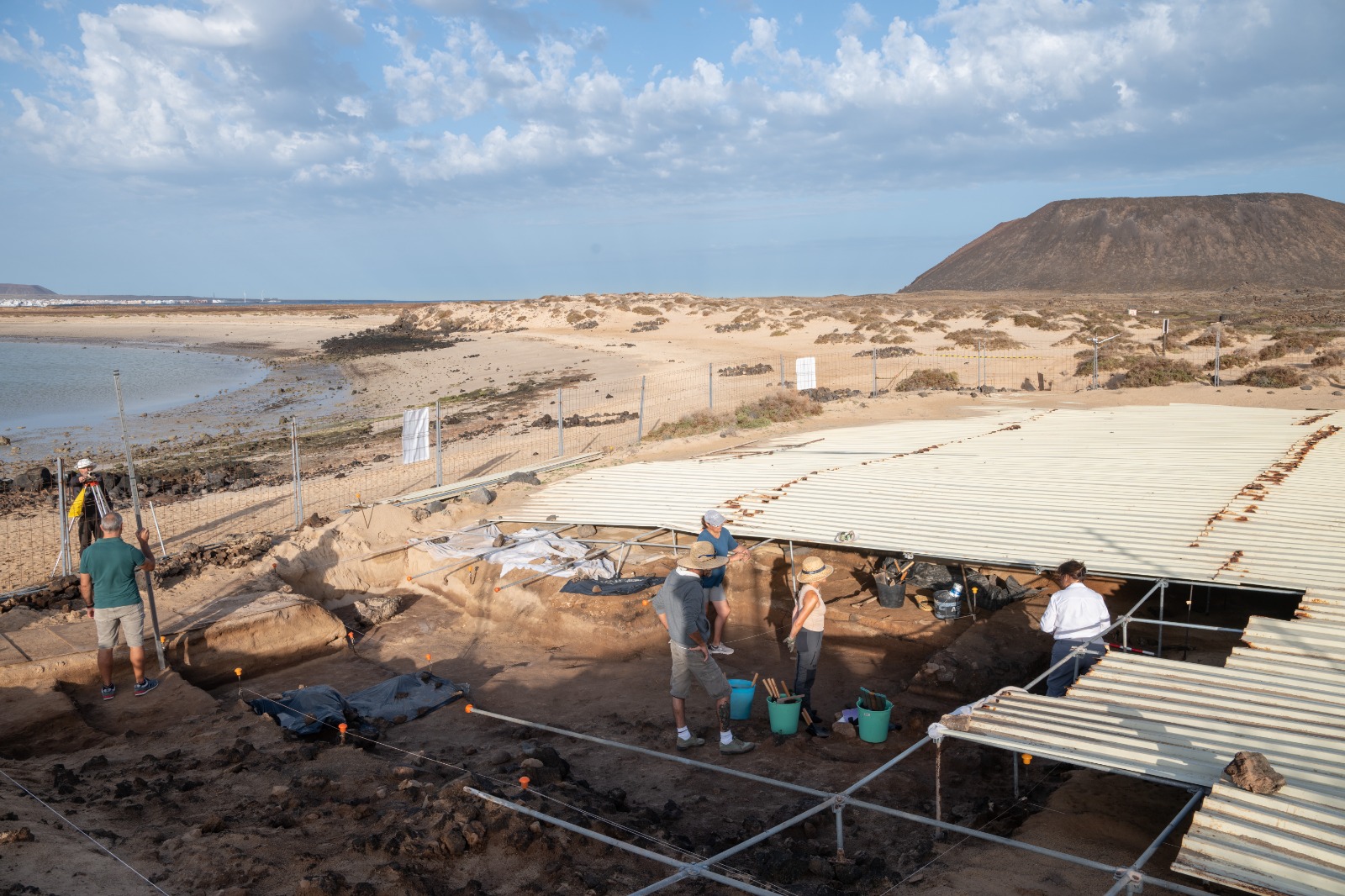
The Cabildo de Fuerteventura and the Cabildo de Tenerife are launching a new archaeological excavation campaign on the Islote de Lobos, to run between 25 October and 10 November 2026. The interdisciplinary team will focus its work on the Lobos 5 zone, near La Calera beach, investigating a possible processing site and a lime kiln linked to the production of the prized purple dye in Roman times.
The research forms part of the interdisciplinary project ‘Towards defining the Purpurarias Islands. From the Lobos 1 purple dye workshop (Islote de Lobos, La Oliva, Fuerteventura). Archaeological work on the Islote de Lobos and its surrounding territorial context’, carried out under an institutional and scientific collaboration agreement between the Cabildo de Fuerteventura and the Cabildo de Tenerife, through their respective archaeological museums, with support from the Universidad de La Laguna and BinterCanarias.
New work in the Lobos 5 area
This eleventh campaign will concentrate its efforts on the archaeological area known as Lobos 5 (L5), located to the northwest of the well-known Lobos 1 workshop, near La Calera beach. This is an area of dune landscape and sandy terrain (jable) where previous surveys have identified Roman and historical ceramic fragments.
One of the main objectives will be the excavation of a badly deteriorated and partially collapsed lime kiln. Lime played an important role in the Roman dye industry, as it was used as an alkaline agent in treating the hypobranchial glands of the purple-producing molluscs, such as the dye murex (Stramonita haemastoma). This process was essential for obtaining the violet pigment.
A key site for understanding the Roman presence in the Canaries
The archaeological site on the Islote de Lobos, dated between the 1st century BC and the 1st century AD, marked a significant advance in understanding the commercial and industrial links between Roman Hispania and the Canary Islands. Its discovery made it possible to document productive activity connected to the maritime routes linking the archipelago with areas around the Bay of Cádiz and the Lower Guadalquivir.
Archaeological work has documented more than 200,000 Stramonita shell apices, dry-stone dwelling structures, copper and iron tools, fine terra sigillata tableware, oil lamps and fragments of lead cauldrons used in the dye-extraction process. These finds point to the existence of a seasonal factory of great significance for understanding Roman economic activity in the Atlantic.
The purple dye obtained from these molluscs was highly valued throughout the Mediterranean world and was particularly associated with the clothing of the elite and the imperial family. The continuation of research at Lobos allows for a deeper understanding of this exceptional site and provides new insights into the relationship between the Canary Islands and the Roman world, as well as into the ancient history of the archipelago.