



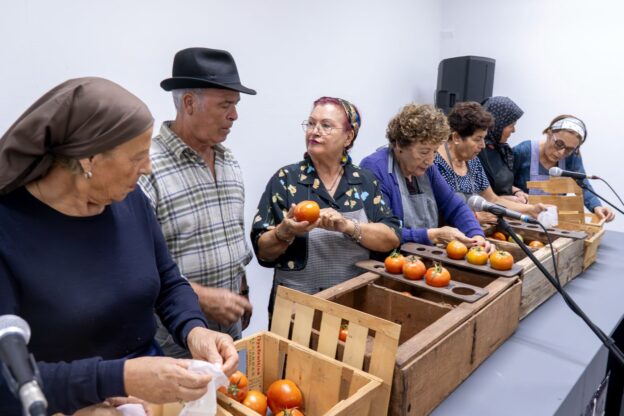
The event, held at its headquarters in Llanos de La Higuera, looked back over the cooperative’s history, heard about the experience of the La Aldea cooperative and received an award from the Cabildo
The Gran Tarajal Agricultural Cooperative celebrated its 80th anniversary this Friday with an event at its headquarters in Llanos de La Higuera (Tuineje), looking back at those who have written its history, with a special tribute to the women who worked in tomato production for decades. The event, organised by the cooperative itself, was held in collaboration with the Cabildo de Fuerteventura’s Department of Agriculture, Livestock and Fisheries.
The event was attended by the president of the Cabildo, Lola García; the mayor of Tuineje, David Herrera; the councillor for Agriculture, Livestock and Fisheries, Enrique Pérez, and the councillor for Economic Promotion, Nuria Cabrera. The evening opened with a performance by the Acaicate association, with music marking the pace of the programme, which also featured a contribution from Marcelo Rodríguez Quintana, general director of the La Aldea de San Nicolás agricultural cooperative (COAGRISAN), who shared with those present the experience of an organisation with which Gran Tarajal shares history, challenges and tomato-growing roots.
The president of the Cabildo, Lola García, recalled that the cooperative was born when a group of smallholders, men and women alike, decided to produce and sell together on arid land. “At a time when food barely reached Fuerteventura, the cooperative helped supply the island and gave work to many families. And majorero tomatoes went from here to mainland Spain and to different countries across Europe,” she said.
García also stressed that “when we buy a tomato, a vegetable or a cheese from Fuerteventura, we help sustain employment in our towns and keep alive a way of life that is part of our identity.” She paid tribute to those who founded the cooperative in 1946 and to those who have chaired it since, with a special mention for Juan de Saá, who led it for almost three decades and was honoured this year at FEAGA. She also had words of recognition for the women of the majorero countryside, who “for many years worked the tomato fields without receiving the recognition they deserved.”
The mayor of Tuineje, David Herrera, highlighted an event that honours the trajectory of the Gran Tarajal Agricultural Cooperative and thanked the Cabildo de Fuerteventura for its support in making it possible. He also stressed that the cooperative is part of the municipality’s history and identity, and praised the work of the farming families who have sustained its activity over eight decades.
For his part, Enrique Pérez noted that the cooperative’s history shows that “coming together works.” “Eighty years ago, a group of farmers understood that by selling together, they had greater strength. That idea still holds true today, with water supply, production costs and double insularity as major challenges. From the Department, we work hand in hand with the sector so that majorero farming continues to provide a livelihood for new generations,” he said.
The councillor for Economic Promotion, Nuria Cabrera, described the cooperative as “a symbol of the resilience and struggle of the majorero people” and recalled a period of prosperity when the crop became one of the main economic activities in the south of the island, with a special mention for the women of the tomato harvest, “heroines who made this crop Fuerteventura’s leading export.” Cabrera also reaffirmed the economic support the primary sector will continue to receive from the Cabildo, mindful of “the difficult situation it faces in the current international context.” “Together, administration and sector alike, we must help the primary sector recover and become one of the main engines of our economy, as it has historically been,” she added.
Eighty years of tomatoes and cooperation
The event included a panel discussion looking back at the cooperative’s history, featuring technician Jorge Mesa, Marcelo Rodríguez and two women from the tomato harvest, Fátima Marrero and Ángela Brito Armas, which traced the various stages of an organisation that has managed to adapt to each era.
The cooperative was founded in 1946, when 34 members, led by Sebastián Ramos Ramos, joined forces to defend the work of local farmers and ensure a fair outlet for their harvests. In the 1960s, with Tuineje accounting for three-quarters of the island’s tomato production, it was reconstituted, took on new members, opened its own packing warehouse and began exporting directly to Europe under the Ramos tomato brand. At its peak, it brought together almost 300 farmers.
Behind that history were the women of the harvest, who for decades worked in tomato production, from the fields to the packing houses, and sustained much of the activity that took majorero tomatoes to European markets. Their testimony, present at the panel and in the memory of the event, is an essential part of the cooperative’s history and of the role of rural women in the island’s economy.
Eight decades on, the cooperative remains active and continues to adapt year after year. Since 2022 it has entered a new chapter at Llanos de La Higuera, restoring its packing and nursery areas and providing technical training for new producers.
The event closed with the president of the Cabildo presenting the cooperative with an award to mark its anniversary, as a gesture of thanks for eight decades of work, followed by a group photograph to mark the occasion.